In-home consumer behavior · Food & beverage

Consumers say one thing. Your launch depends on what they do.

We film your product being used in real kitchens and turn it into evidence you can defend — so you walk into your gate review with what people actually did, not what they said they would. One week from kickoff.

Founded by researchers at Wageningen University & Research

The say-do gap

Ask them and they’ll say yes.

Watch them at 7pm on a Tuesday — two kids in the kitchen, a pan already hot — and you learn something else entirely.

Surveys measure what people say. Launches are decided by what they do.

How it works

Validate your product in one week.

Real consumers, real kitchens, real dining tables. Four steps, no lab, no six-week wait — and a fraction of the cost of a traditional central-location test. Just a record of what happened, ready for your next gate review.

Step 01

Brief

Tell us your goal, your target consumers, and which products you want tested.

Step 02

Recruit

We find and screen consumers who match your target audience.

Step 03

Test at home

They use your product in their own kitchen, on video, unscripted.

Step 04

Results

You get the analysis in your dashboard one week after kickoff.

The platform

See what happens from shelf to table.

Qualitative and quantitative, in one study. Vox captures what your consumers say. Domus captures what they do with your product at home. Studio turns the two into a decision.

Vox interview
Vox

Find out why people would buy it — or wouldn’t

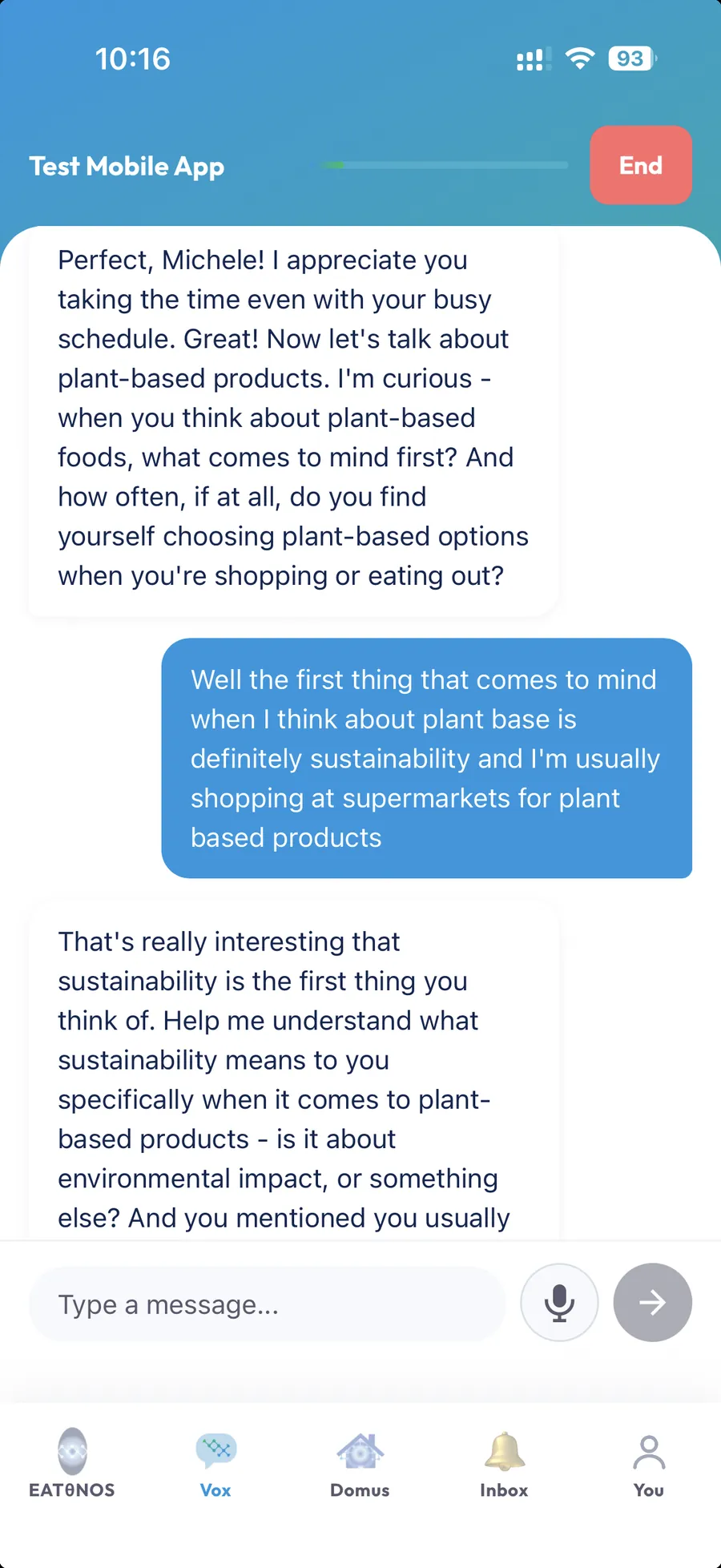
An AI moderator interviews your target consumers on video from their own phone, then transcribes and themes every answer for you automatically.

Purchase drivers Brand perception Competitor benchmarking Results in 2 days
In-home test
Domus

Watch your product being used at home

Consumers cook, taste and store your product in their own kitchen on video, and the AI codes every step, word and reaction — including the friction a survey never shows you.

Step-by-step behavior Friction points Sentiment analysis Results in 1 week
Eatpol Studio
Eatpol Studio

Every study in one dashboard you can ask questions

Transcripts, behavioral patterns and recommendations sit in one place, and you can ask in plain language — the answer comes back grounded in your own study data.

Real-time results Behavioral coding AI recommendations Team sharing
Proof

What we’ve measured so far.

Every winning pack from the world’s food awards, decoded — plus the live category trends we use to brief your study.

0Award & innovation products indexed
0Country trends tracked
0Food categories
1Week from kickoff to results

50–75% of new food products fail within two years (peer-reviewed estimates; industry panels put it as high as 85%). Most of them were approved on stated intent.

Traditional testing gave us a score, not a direction. Eatpol was completely different — seeing how consumers actually use our products at home gave us insights we could act on. We brought them into a retailer conversation and walked out with an extra SKU at Albert Heijn. We call it Eatpol proof.

Annick van de LaakCreative Concept Designer, QSTA
Privacy & Ethics

How we handle your data.

Faces are auto-masked, we store de-identified signals only, and every study runs under GDPR.

Lawful basis

Consent-based collection with clear purposes, GDPR-compliant; participants can opt out at any time.

Security

Encrypted storage, strict access controls, and time-bound retention. A DPA is available on request.

Transparency

Participants see what is collected, why, and how it is used. Read our Privacy Policy.

Good to know

Frequently asked.

What is the say-do gap?

The say-do gap is the distance between what consumers report in surveys, panels and focus groups and what they actually do with a product in their own home. People are not being dishonest — a survey simply asks them to predict their own behavior, and prediction is unreliable once a real kitchen, a real evening and a real price are involved. Peer-reviewed estimates put new food product failure at 50–75% within two years, and industry panels put it as high as 85%; decisions taken on stated intent are a large part of why. Eatpol closes the gap by recording what people really do with your product at home, so a go/no-go rests on observed behavior rather than stated intent.

How is privacy handled?

Faces are auto-masked in videos; we store de-identified signals only and comply with GDPR. All personal identifiers are removed from video footage, and test data is encrypted at rest. We provide a Data Processing Agreement (DPA) on request for enterprise clients. Testing participants can request deletion of their data at any time per GDPR Article 17 right-to-be-forgotten requirements. Our infrastructure meets international data protection standards.

Do we need special hardware?

No special hardware is required. Testers use their own smartphones (iOS or Android). We provide simple setup guidance directly inside the Eatpol app, and technical support is available throughout the test. The app is optimized for battery efficiency and does not require high-end devices — any modern smartphone works. Most testers report setup takes fewer than 5 minutes.

How fast are results?

From kickoff to results in 1 week on average. Consumer interviews (Vox) can be completed in as little as 2 days. In-home product testing (Domus) runs in parallel with consumer recruitment and typically completes in 7-10 calendar days. Results appear in your Eatpol Studio dashboard as soon as testing concludes, with AI-powered analysis and actionable insights ready for immediate review. This is 4-6 weeks faster than traditional sensory lab studies.

Can we compare against competitors?

Yes, absolutely. You can include one or multiple competitor SKUs in your consumer test. We report relative performance metrics (purchase intent, emotional response, friction points) and identify key drivers of preference. Competitive benchmarking is useful for understanding market positioning and identifying product improvement opportunities relative to existing solutions in your category.

What if samples require cooking?

We capture all preparation and cooking steps as part of the test methodology. This allows us to connect consumer outcomes (satisfaction, purchase intent, friction) with real-world usage patterns. Our AI analyzes behavior during preparation (ease of use, time investment, any complications) and connects it to final product evaluation. This realistic context significantly improves predictive accuracy compared to pre-prepared samples in lab settings.
Kickoff to results in one week

See real people use it —
before your launch does.

Book a call and we will show you what one week of evidence from real kitchens looks like in your category.

Book a call